

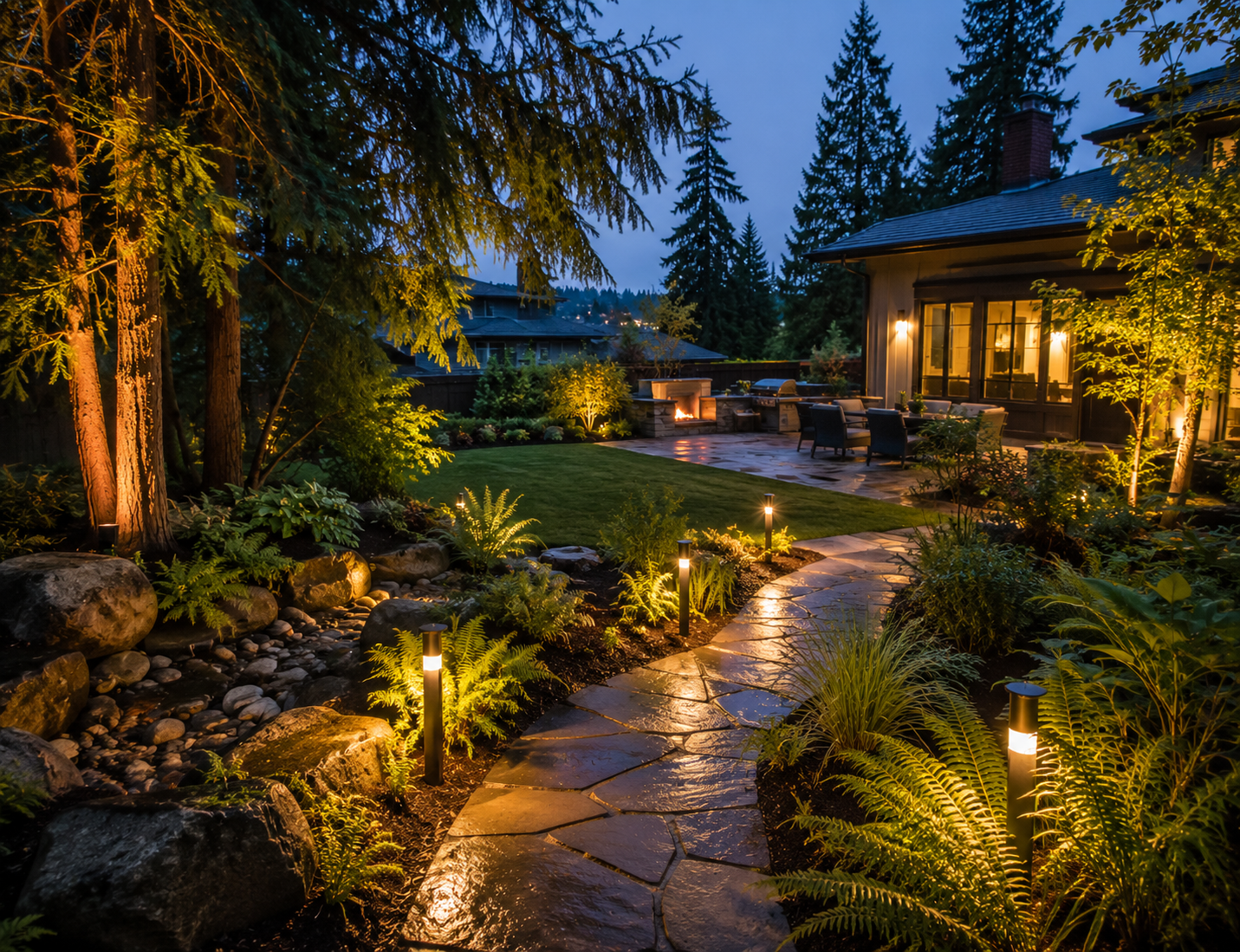
By the time November rolls around, the sun sets on a Seattle backyard before most people even leave work. That short winter daylight window is exactly why landscape lighting for Seattle backyards has become one of the most requested upgrades we install, and it does far more than just look good after dark.
Why Seattle’s Short Winter Days Change the Equation
Seattle loses daylight fast heading into winter, with sunset arriving around 4 30 in the afternoon by December. That means a backyard that gets plenty of use in summer can go completely dark for most of the time people are actually home. Good landscape lighting for Seattle backyards extends usable outdoor time well past sunset, turning a yard that sits unused for five months of the year into something you can actually enjoy after work.
Safe Footing on Wet Paths and Steps
Rain is a fact of life here, and wet pathways, steps, and uneven grade changes become genuine tripping hazards once the light fades. Path lights and step lights placed at consistent intervals do more than add ambiance, they mark exactly where the ground changes elevation so guests and family members are not guessing in the dark. This is one of the most practical reasons homeowners request landscape lighting for Seattle backyards rather than treating it as a purely decorative choice.
Highlighting Evergreens and Japanese Maples
Seattle yards lean heavily on evergreens, layered conifers, and Japanese maples for structure, and these plants photograph beautifully under uplighting. A well placed fixture at the base of a mature Japanese maple casts dramatic shadows from its branching structure, while grazing light along a hedge of evergreens adds depth and texture that flat daylight never quite captures. These plantings tend to be the focal points we design lighting plans around first, since they are usually the most established and visually interesting features already in the yard.
Moisture Rated Fixtures for Constant PNW Damp
Not every outdoor fixture is built for the kind of sustained dampness Seattle sees for months at a time. Fixtures rated for wet locations, rather than the lighter damp location rating, hold up far better against standing water, condensation, and the near constant moisture that settles into garden beds through fall and winter. Because water and electricity together create a real shock hazard, the transformer supplying any low voltage system should always be plugged into a GFCI protected outlet, a safety point the U.S. Consumer Product Safety Commission has highlighted as one of the most effective ways to prevent electrical shock around the home.
Smart Control Options Homeowners Ask About
Timers and app based controls have become a common request, letting homeowners set lights to come on automatically as it gets dark rather than remembering to flip a switch every evening. Given how much sunset time shifts between June and December in Seattle, a smart timer that adjusts automatically saves homeowners from having to reset schedules every few weeks. If you already have other outdoor upgrades in progress, our landscape design and installation services team can plan lighting alongside plant beds and hardscaping rather than adding it as an afterthought.
Seasonal Adjustments Worth Planning For
Because Seattle’s sunset times swing so dramatically between June and December, a lighting plan that only accounts for summer evenings misses the point. Landscape lighting for Seattle backyards should be designed with winter darkness in mind first, since that is when the system earns its keep most. Areas near entryways, driveways, and steps deserve the strongest, most reliable coverage, while decorative accent lighting on plantings can be scaled back or dimmed during the darker months without sacrificing safety.
Choosing Warm Versus Cool Toned Fixtures
Color temperature makes a bigger difference than most homeowners expect. Warm toned fixtures, generally in the 2700 to 3000 kelvin range, complement the greens and browns found in most Seattle landscaping and feel more inviting near patios and seating areas. Cooler, bluer toned light can work for modern architectural features but tends to look harsh against natural plantings. Sticking with warm tones throughout a yard, with only occasional cooler accents on specific hardscape features, usually produces the most cohesive result.
Layering Light Instead of Overdoing It
The most common mistake in backyard lighting design is treating every fixture the same way. A stronger layout mixes:
- Path lights placed at consistent intervals for safety
- Subtle uplighting on key trees or architectural features
- Softer accent lighting near seating and gathering areas
This layered approach reads as more natural after dark and avoids the flat, overlit look that makes a yard feel more like a parking lot than a garden.
Pairing Lighting With a Low Maintenance Yard
For homeowners who are also rethinking their overall landscaping, our guide on low maintenance landscaping in Seattle covers plant choices and layout decisions that pair naturally with a lighting plan, since both projects benefit from being designed together rather than layered on top of each other after the fact.
Planning Around How the Yard Is Actually Used
The most effective landscape lighting for Seattle backyards starts with a walkthrough of how the space gets used after dark, not just where the prettiest plants happen to sit. A family that grills on the patio most evenings needs strong, even light over that area, while a yard used mainly for quiet evenings on a deck might call for softer, more scattered accent lighting instead. Mapping out these everyday habits before choosing fixture placement tends to produce a far more useful result than lighting the yard purely for how it looks in photos.
Get a Lighting Plan for Your Yard
Landscape lighting for Seattle backyards works best when it is planned around your specific plants, pathways, and how you actually use the space. The team at Lake East Landscape has designed outdoor spaces across the Puget Sound region for more than 25 years, and you can see recent lighting projects and client reviews on our Google Business Profile. Reach out for a free consultation.
Frequently Asked Questions
How much does landscape lighting for Seattle backyards typically cost?
Cost depends on the number of fixtures, wiring complexity, and whether smart controls are included. A basic path and accent lighting package generally costs less than a full whole yard system with uplighting on multiple trees.
Do landscape lights need to be professionally installed?
Low voltage kits can technically be installed as a DIY project, but professional installation ensures correct fixture placement, proper wire burial depth, and GFCI protected wiring that meets electrical safety standards.
What type of bulbs work best for Seattle’s climate?
LED bulbs are the standard choice, since they generate less heat, use less energy, and hold up well to the region’s cool, damp conditions compared to older halogen options.
Can landscape lighting run on a timer?
Yes, most modern systems include a timer or smart app control that adjusts automatically as sunset times shift throughout the year, so you do not need to manually reset the schedule.
Will landscape lighting attract more slugs or pests to my yard?
Properly placed landscape lighting has minimal impact on pest activity. Warm toned LED fixtures are generally less attractive to insects than brighter white or blue toned lighting.


