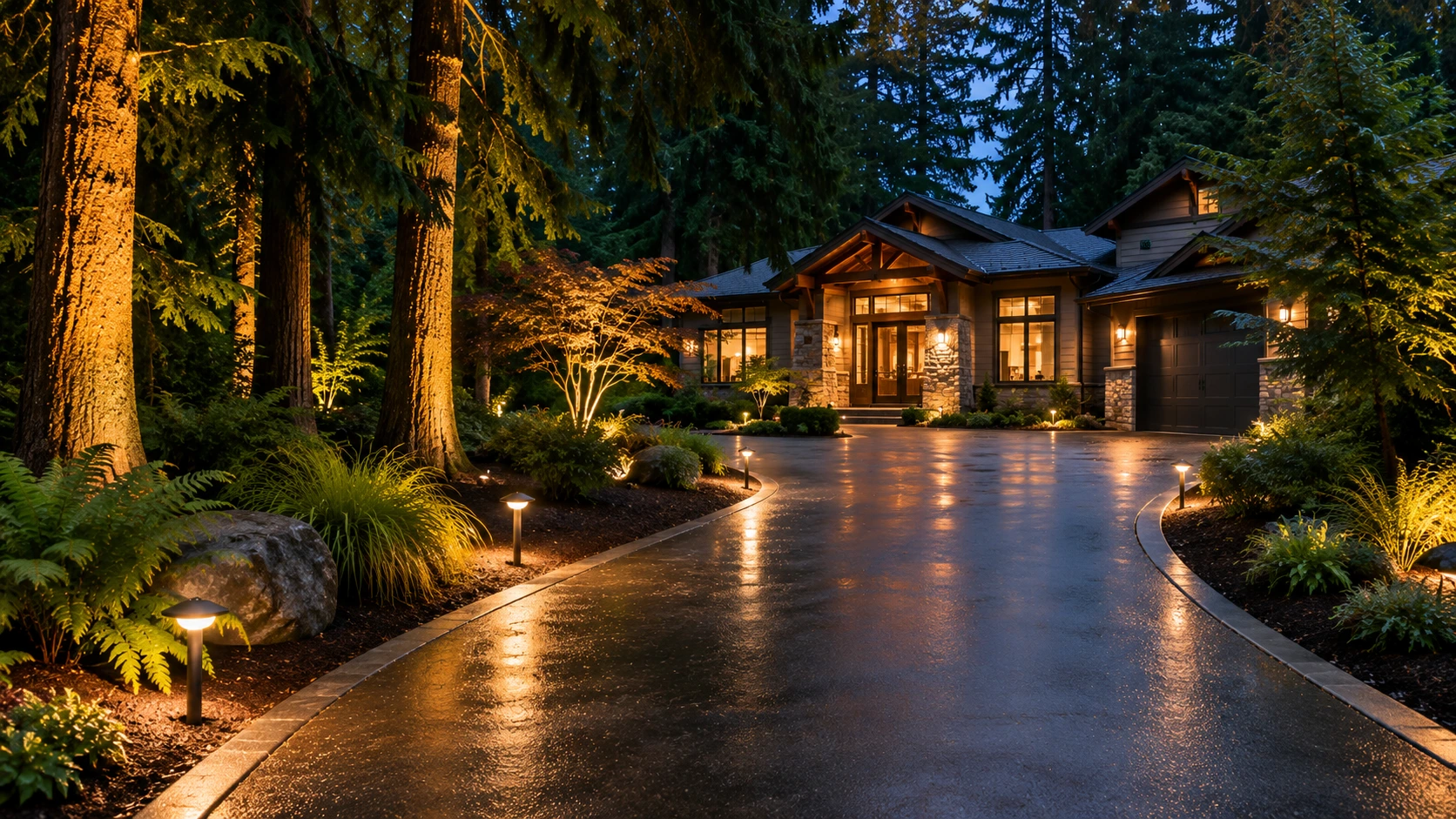
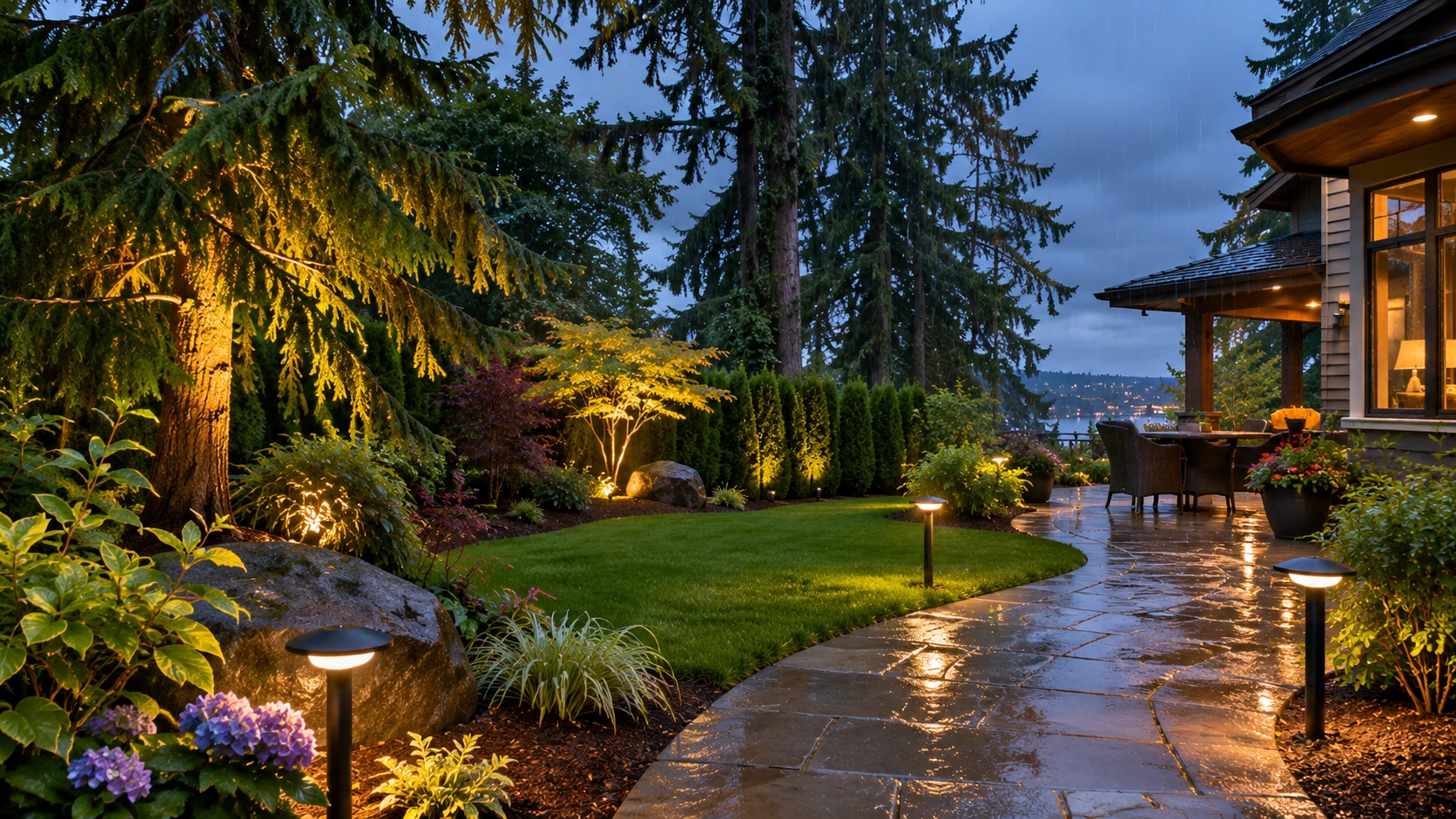
Your yard looks wonderful at noon, and then the sun sets at four in the afternoon and half of it disappears into the dark. That is the reality of a Pacific Northwest winter, and it is why so many homeowners start looking at outdoor lights in the fall. The first question is usually whether to buy the cheap solar stakes from the garden center or invest in a real wired system. If you are comparing options for your property, our team handles Bellevue landscaping services and lighting across the Eastside, and here is how solar vs low-voltage landscape lighting really stacks up in this climate.
How Solar Landscape Lights Work
Solar lights are self contained. Each fixture has a small panel, a rechargeable battery and an LED. During the day, the panel collects sunlight and charges the battery. At dusk, a sensor turns the light on and it glows until the battery runs low.
The appeal is obvious:
- No wiring, trenching or electrician
- Easy for a renter or a quick weekend project
- Low upfront price per fixture
- Placement is flexible, since you can stick a light anywhere
For a sunny, dry climate, that convenience makes a lot of sense. In Seattle, it runs into a wall.
How Low-Voltage Landscape Lighting Works
Low-voltage lighting runs on 12 volts instead of the 120 volts used in your house. A transformer plugs in or is wired to an outdoor circuit and steps the power down. Cables then run underground or along beds to individual fixtures, usually with LED bulbs.
Because the power comes from your home, the lights do not depend on the weather. A timer or photocell turns them on at dusk and off at a set time, so the system runs the same every night in January as it does in June. Low voltage also keeps shock risk down compared with full line power, which is why it is the standard for residential landscape design.
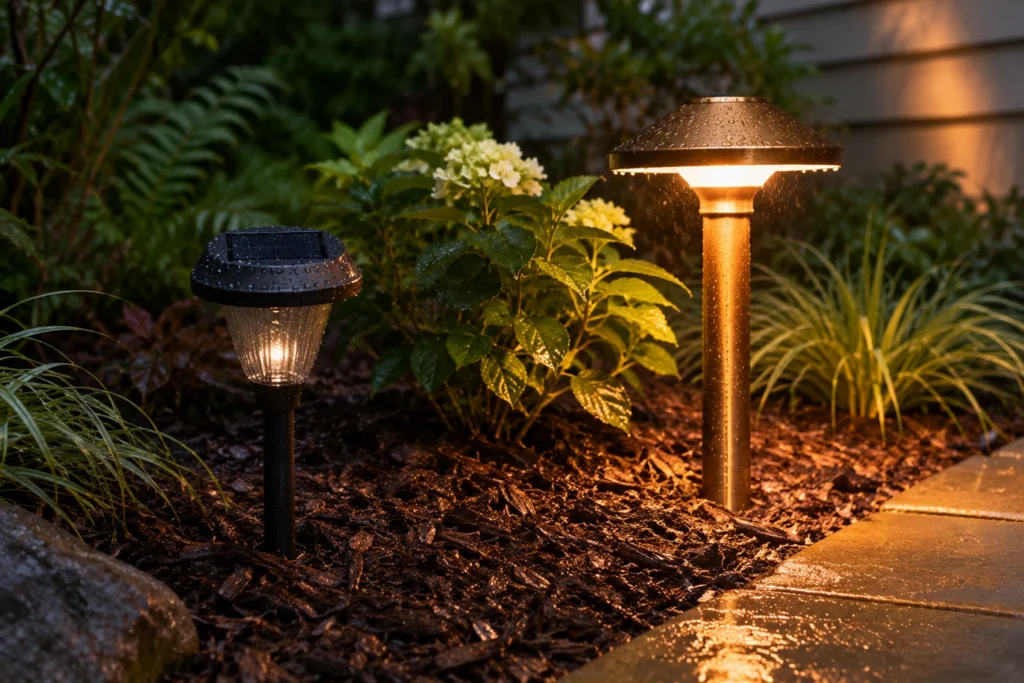
Solar vs Low-Voltage Landscape Lighting in a Seattle Winter
Here is where the comparison becomes lopsided for the Puget Sound region. Solar needs strong, direct sun to fully charge. From October through March, Seattle sees short days, heavy cloud cover and frequent rain. The Seattle climate data from the National Weather Service shows how few bright, clear days we get in winter.
Here is what that means for solar lights:
- Batteries rarely reach a full charge in December and January
- Lights come on dim and turn off after only an hour or two
- Shaded yards under evergreens and large maples get almost no charge
- Sunset around 4 PM means you need light exactly when solar is weakest
In practice, many solar fixtures work well for a few summer months and are a disappointment the rest of the year. If your priority is a yard that looks good in the dark winter evenings, solar usually cannot deliver.
Brightness and Light Quality
Brightness is another gap. Most solar fixtures are small, with modest lumen output. They are fine for a soft glow along a path, but they struggle to light steps, highlight a tree or wash a wall.
Low voltage gives you far more control. A designer can choose a wide range of fixtures, beam angles, color temperatures and brightness levels, then layer them to create depth. You can uplight a big cedar, graze a stone wall, light steps for safety and add soft path lights, all on the same system. Dimmable transformers and smart controls take it even further. The Department of Energy has useful outdoor lighting basics on choosing efficient LED fixtures and controls.
Durability in Constant Pacific Northwest Rain
Rain and moisture are tough on cheap hardware. Many solar fixtures use thin plastic housings, small batteries and weak seals. After a few wet winters, you will often see cloudy lenses, corroded contacts and dead batteries.
Quality low-voltage fixtures use solid brass, copper or heavy duty aluminum, sealed lenses and waterproof connectors. They are built to sit in wet soil for years. With basic care, a well installed system keeps working season after season.
Solar vs Low-Voltage Landscape Lighting Cost Over Time
Solar looks cheaper on day one. A bag of solar lights costs a fraction of a professionally designed system. But the real comparison is the cost over five or ten years.
- Solar: Batteries often need replacing every year or two, and entire fixtures are often replaced after a few seasons.
- Low voltage: LED bulbs can last for tens of thousands of hours, and the fixtures can last a decade or longer.
Add the time you spend swapping batteries, resetting stakes and replacing broken lights, and the gap closes quickly. For many homeowners, one well designed low voltage system costs less than several rounds of replacement solar.
Control, Timers and Safety
With low voltage, you decide when the lights come on and how long they stay on. Timers and photocells make it automatic. You can add zones, so your front entry, driveway and backyard run on different schedules.
Safety is part of the value. Good lighting makes steps, walkways and driveways easier to see, helps guests find the door and discourages trespassers. A reliable system matters most in the dark months, which is again where solar falls short.
When Solar Still Makes Sense
Solar is not useless. In the solar vs low-voltage landscape lighting question, it can still be the right choice when:
- You want a short term, low cost accent for a summer party
- A sunny, open spot gets full sun most of the day
- Running wire is not practical, such as a far corner or a temporary space
- You are experimenting before investing in a full design
Think of solar as a decoration, and low voltage as infrastructure. Both have a place, but they are not interchangeable.
Planning Your Lighting in Seattle and Bellevue
Whichever side of the solar vs low-voltage landscape lighting debate you lean toward, the best plans start with how you use your yard. Where do you walk at night? Which trees, walls or features do you want to show off? Where do you need extra safety? Once you map that out, a designer can place fixtures, size the transformer and route the cable to avoid roots, beds and future projects.
Our crew handles professional landscape lighting installation for homes in Seattle and Bellevue, and lighting often fits naturally into a larger plan from our landscape design team. You can also read what neighbors say in the Lake East reviews before you get in touch.
Frequently Asked Questions
Which is better in Seattle, solar vs low-voltage landscape lighting?
For most homes, low voltage. Seattle’s short, cloudy winter days leave solar lights under charged, while low voltage runs on steady home power all year.
How long do solar vs low-voltage landscape lighting systems last?
Solar fixtures often need new batteries every year or two and replacement after a few seasons. Low voltage LED systems can last a decade or more with basic care.
Can solar lights work in the Pacific Northwest at all?
They can in summer or in a spot with full sun. Through fall and winter, expect weak and short lived light.
Does low voltage lighting cost a lot to run?
No. LED fixtures use very little power, and a timer or photocell keeps run times efficient.
Is low voltage lighting safe in wet weather?
Yes. It runs at 12 volts and uses waterproof connectors, which makes it a standard choice for outdoor use.
Can I add lights to a low voltage system later?
Usually yes, as long as the transformer has enough capacity. A good installer plans for extra fixtures from the start.